The 12 Percent Discount That Buys Two Airport Routes and a Township You Can Walk Through
Hennur–Thanisandra trades twelve percent below Hebbal because it offers the same employment-corridor exposure with greater geometric leverage — two airport access routes, three Phase 2B metro stations near the Hennur junction, and the only studio-through-4 BHK configuration ladder in north Bengaluru. Twelve percent is the cluster-maturity discount.

If you exit Manyata Tech Park at 7 PM on a Wednesday, the road that gets you home in 12 minutes — not 35 — is Hennur Main Road heading north. That's the small fact a sizeable portion of the GCC workforce living in north Bangalore has worked out over the past three years, and it's the small fact that explains why Hennur–Thanisandra Road exists as a residential cluster.
The cluster trades at ₹16,000 per square foot — twelve percent below Hebbal–Jakkur's ₹18,000 — for what is, on the office-corridor exposure side, very nearly the same buy. Manyata Tech Park sits four kilometres south. The KIADB Aerospace Park stack at Devanahalli is twenty kilometres north. The cluster sits at the intersection of two airport access routes (Bellary Road on the west, Hennur–Bagalur Road on the east) and three BMRCL Phase 2B metro stations land within walking range of the Hennur junction.
That last point is the buried lede. The metro proximity here is closer than Hebbal's. The closest station, Kalyan Nagar, sits 85 metres from the Hennur intersection. And the Package 1 south-end stations remain targeted for June 2026 — months before the Hebbal-end of the same package even tries to open.
The 42 triggers nobody flags
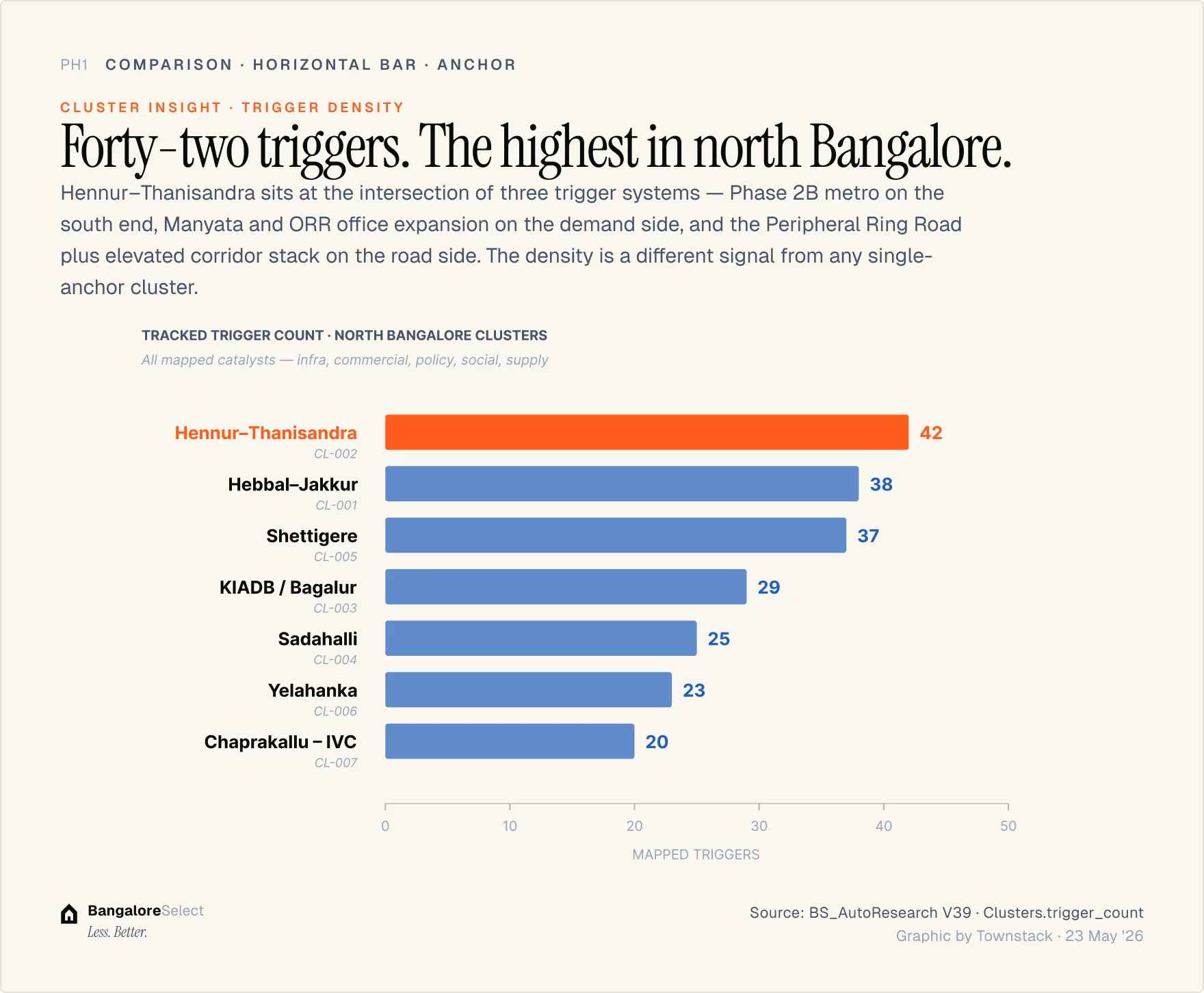
Hennur–Thanisandra has the highest tracked-trigger count of any north Bangalore cluster — 42 mapped events, versus Hebbal's 38, KIADB's 29, Shettigere's 37. The number is high because the cluster sits at the intersection of three trigger systems. Phase 2B metro on the south end. Manyata and ORR office expansion on the demand side. The Peripheral Ring Road northern arc and the Bangalore Business Corridor Package 1 elevated corridor on the road-infrastructure side. Eighteen of the 42 carry high impact at confirmed certainty.
That density is a different signal from KIADB's. KIADB has six high-impact employer triggers concentrated in an eight-kilometre arc. Hennur–Thanisandra has eighteen high-impact triggers spread across a corridor. KIADB tells you who's going to want a house here. Hennur–Thanisandra tells you what's going to happen to the geography around the houses already here.
Bhartiya City, lived in
Most pre-launch buyers commit to a lifestyle fabric that doesn't exist yet. Bhartiya City does. The 100-acre integrated township at Thanisandra carries an operational IT park, a school, a hotel, and a mall. Buyers at Nikoo Thanisandra's eighth phase pre-launch can walk through the master plan before signing — which is, in north Bangalore's pre-launch market, the rare cluster where this is genuinely true.
That single fact does more work than any infographic. Pre-launch buying is, fundamentally, a leap of faith on what a township will feel like in 2031. Bhartiya City lets you stand inside one in 2026 and verify. Whether that tells you to buy or walk depends on what you find. Either way, you're not guessing.
Where the metro actually walks
Kalyan Nagar Phase 2B station is 85 metres from the Hennur junction. That's the marquee proximity number, and it belongs to one specific corner of the cluster. The rest doesn't get those numbers. The Thanisandra mid-section sits 1.5 to 2 kilometres from the nearest confirmed station. The northern fringe, where TVS Emerald Altura sits, runs further still.
This is the cluster's most consistently mispriced variable. A buyer pricing all of CL-002 against Kalyan Nagar walking distance is paying for proximity they don't have. The same buyer pricing the northern end against ORR-edge averages is undervaluing the metro spillover they will have. The cluster average misleads in both directions. Run the proximity number per project, not per cluster.
The TVS question
TVS Emerald Altura launched in 2022 at ₹17,000 psf (the V22 dataset position) and refreshed downward to ₹13,000 psf at the May 2026 PSF reset. That's a deliberate repositioning move — not a market crash on a single project, but TVS recalibrating to the cluster's actual mid-tier band. The Altura is the cluster's largest standalone launch (975 homes, 12 towers, 10.06 acres) and TVS Emerald's first north Bangalore project. Chennai parent group. Bangalore debut.
The execution-velocity question is the variable to underwrite. RERA completion is March 2033; the developer voluntary possession target is 2030. The three-year gap is material for buyers financing the purchase. The risk isn't TVS Group brand credibility — that's solid. It's north Bangalore execution-cadence calibration for a developer whose Chennai track record won't transfer line-for-line.
The configuration ladder nobody else has
Hennur–Thanisandra is the only north Bangalore cluster with a studio-to-4-BHK configuration ladder in active or pre-launch inventory. Nikoo Thanisandra's studio at 786 sft / ₹98 lakh. TVS Altura's 2 BHK at 1,107 sft / ₹1.49 crore. Puravankara Codename Hennur's 3 BHK at 2,000 sft / ₹3.20 crore. Nikoo's 4 BHK loft at 2,506 sft / ₹3.10 crore.
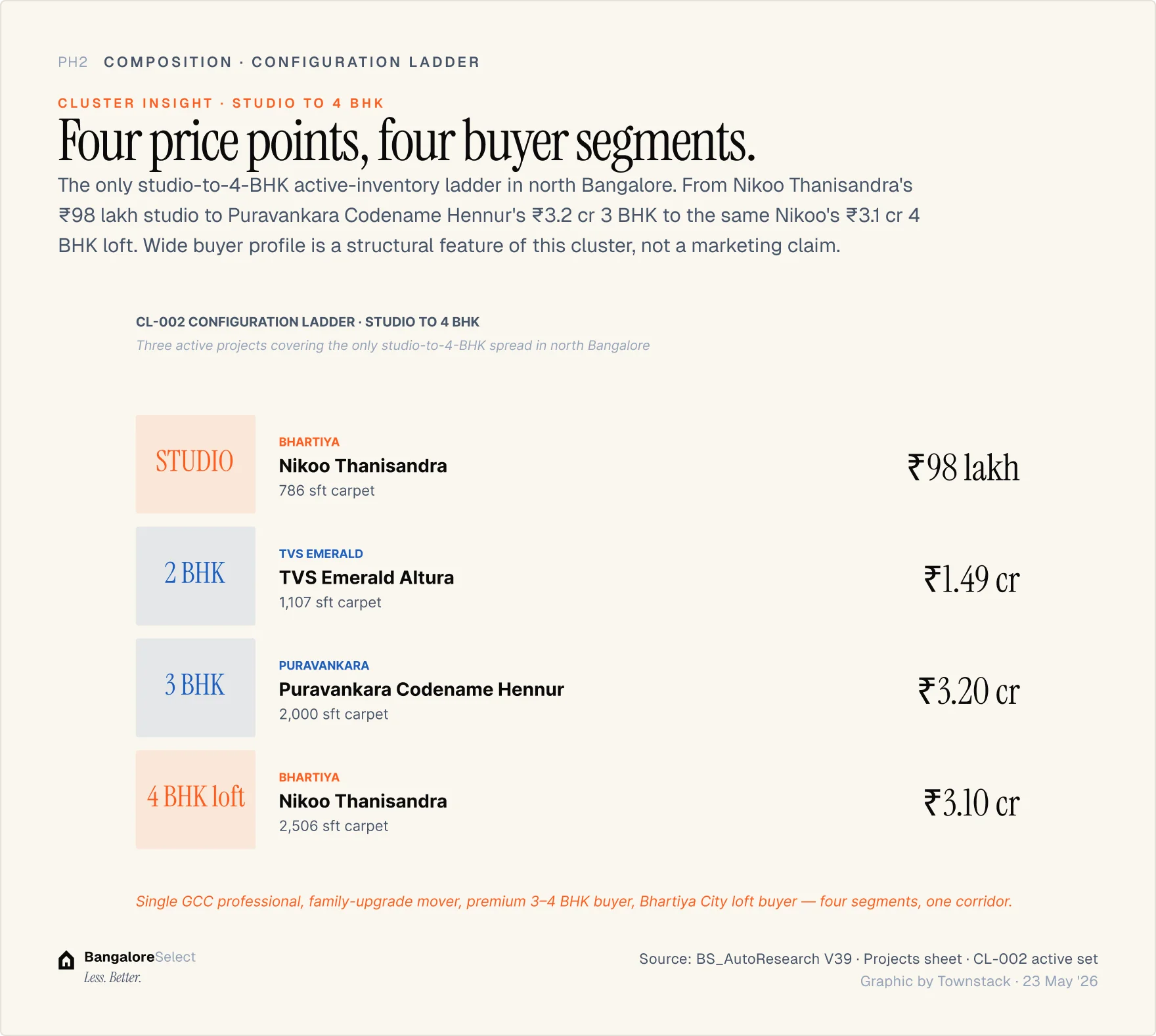
That ladder is what 'wider buyer profile' actually means in practice. The cluster sells to single GCC professionals, family-upgrade movers, boutique 3-4 BHK premium buyers, and Bhartiya-City-lifestyle buyers — all at the same time, all on the same corridor. Most clusters serve one or two of these segments. This one serves four.
What the 12 percent actually buys
The Hebbal-versus-Hennur gap isn't about thesis quality. It's about cluster maturity. Hebbal has the Hebbal Junction multimodal hub, the premium tower density, and the closer-to-CBD positioning. Hennur–Thanisandra has the geometric leverage — bidirectional employment access, dual airport routes, three Phase 2B stations a short walk from one another. Both are rational positions. Twelve percent is the price of trading one set of advantages for the other.
The buyer who fits this cluster reads the 12 percent as a discount on Hebbal's premium and trades up to the configuration ladder. The buyer who doesn't fit reads the same 12 percent as a discount on cluster maturity. Both reads are correct. Which one matters depends on whether the metro arrives at the south-end stations on time, the Manyata Phase 2A occupancy compounds through 2027, and Bhartiya City's commercial component fills out as advertised.
Three reasonable bets. None of them require believing all three resolve favourably to win the position.
Sources. BangaloreSelect Tracked Dataset (BS_AutoResearch W3 22-MAY-2026). BMRCL Phase 2B Package 1 construction: BMRCL official disclosure. Bhartiya City township operational scope: Bhartiya City official. TVS Emerald Altura RERA registration: Karnataka RERA portal.
What the 12 percent actually buys
The Hebbal-versus-Hennur gap isn't about thesis quality. It's about cluster maturity. Hebbal has the Hebbal Junction multimodal hub, the premium tower density, and the closer-to-CBD positioning. Hennur–Thanisandra has the geometric leverage — bidirectional employment access, dual airport routes, three Phase 2B stations a short walk from one another. Both are rational positions. Twelve percent is the price of trading one set of advantages for the other.
The buyer who fits this cluster reads the 12 percent as a discount on Hebbal's premium and trades up to the configuration ladder. The buyer who doesn't fit reads the same 12 percent as a discount on cluster maturity. Both reads are correct. Which one matters depends on whether the metro arrives at the south-end stations on time, the Manyata Phase 2A occupancy compounds through 2027, and Bhartiya City's commercial component fills out as advertised.
Three reasonable bets. None of them require believing all three resolve favourably to win the position.
Read more on the Hennur–Thanisandra cluster page for the live project list, trigger feed, and price-history chart referenced in this article.