The Number Your Builder Won't Show You: Why UDS Changes Your Apartment's Worth
Undivided Share of Land decides three things that will matter for the rest of your ownership: your resale premium, your mortgage eligibility, and your position in any future redevelopment decision. In North Bangalore's township projects, UDS can be as low as 30 sq ft on a 1,500 sq ft apartment.

That one line on your sale deed — Undivided Share of Land — decides three things that will matter for the rest of your ownership: your resale premium, your mortgage eligibility, and your position in any future redevelopment decision.
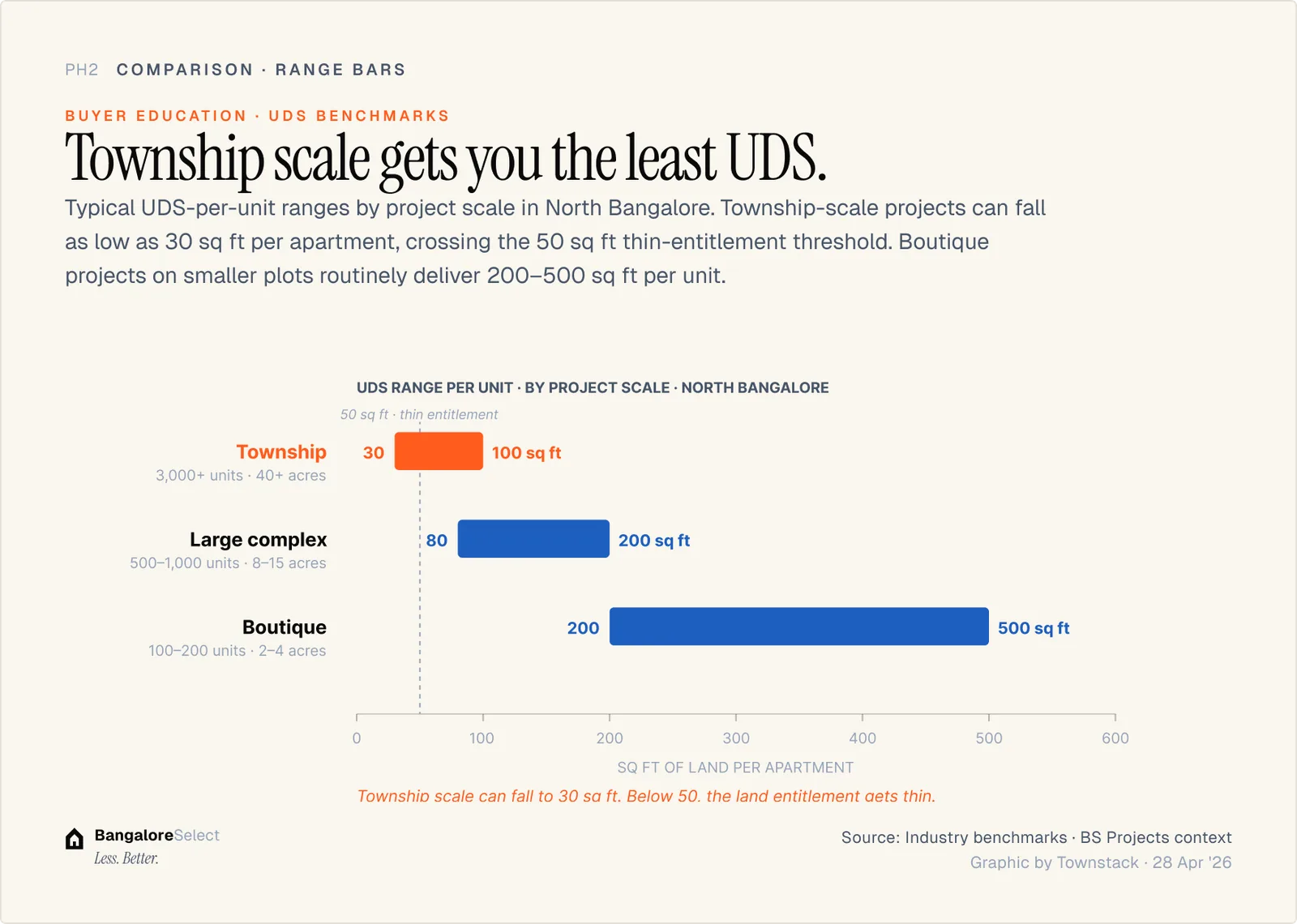
In North Bangalore's township-scale projects, UDS can be as low as 30 sq ft of land for a 1,500 sq ft apartment. Most buyers never ask for the number. They should.
What UDS is
When you buy an apartment, you do not buy the land under the building. The land is held collectively by all apartment owners in the building or project, in proportion to their Undivided Share. Your UDS is your fractional legal entitlement to that land.
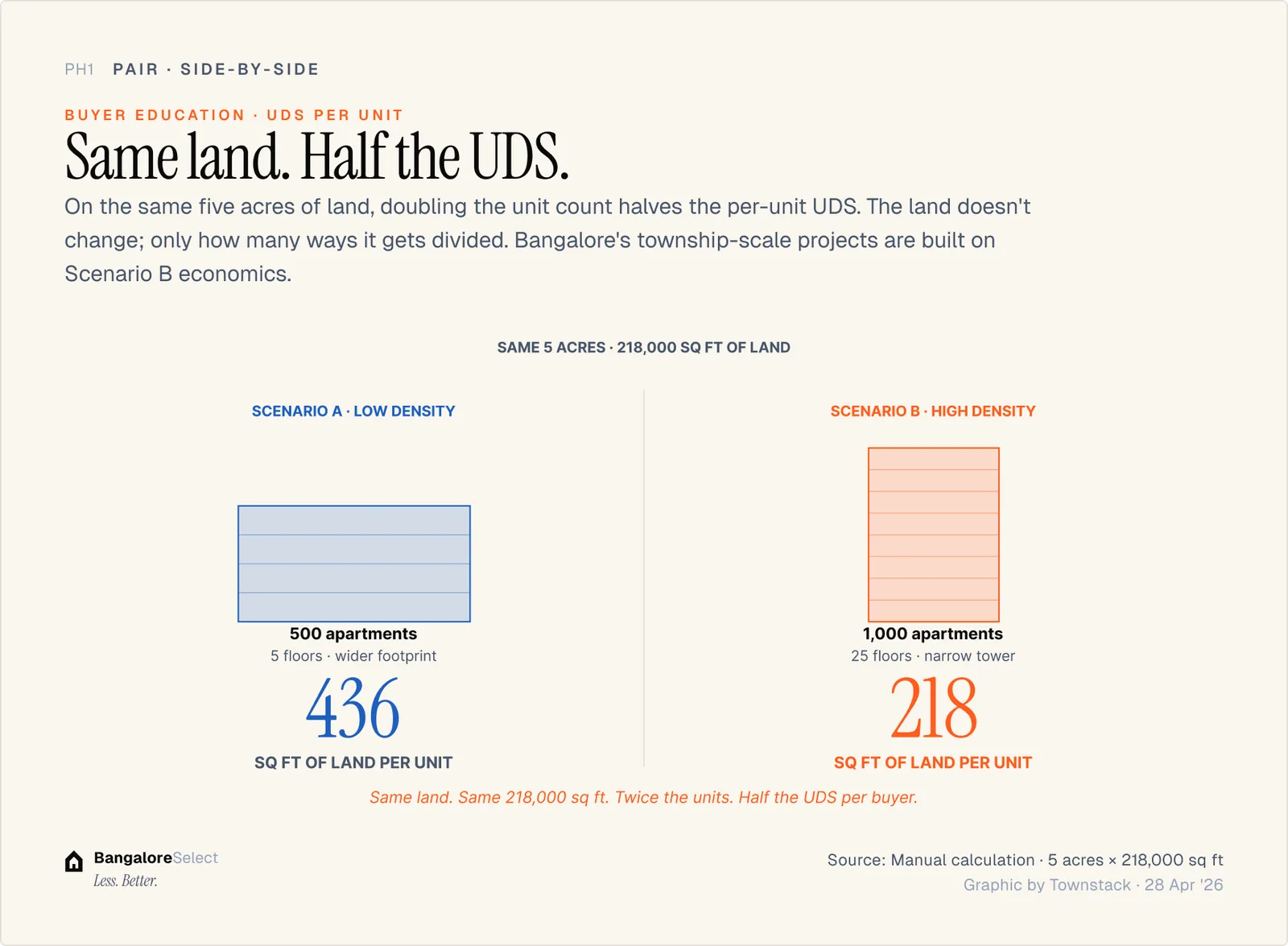
If a project sits on 5 acres (218,000 sq ft) of land and has 500 apartments, the average UDS per apartment is 436 sq ft of land. If the same developer puts 2,000 apartments on the same 5 acres, the average UDS drops to 109 sq ft.
The apartment above you and below you has a similar carpet area. The UDS behind each sale deed is determined by the land-to-unit ratio of the entire project — not by the size of your individual unit.
Why it matters for resale
When a buyer or a bank assesses your apartment's value, they are assessing two things: the constructed area (your carpet area) and the land entitlement (your UDS). An apartment with a larger UDS on appreciating land has a structural resale advantage over one with minimal UDS in a high-density development.
For North Bangalore's township projects specifically, the UDS question is acute because the product type is high-density by design. A 2,000-unit project on 20 acres gives each unit 436 sq ft of UDS. A 500-unit project on 10 acres gives each unit 871 sq ft. Both projects can claim the same carpet area for the same PSF. The land entitlement is completely different.
Why it matters for mortgage eligibility
Banks lend against the combined value of the apartment: constructed area plus land entitlement. In most home loan appraisals, the land component carries a higher weight per square foot than the constructed component — land appreciates; structures depreciate.
A project with very low UDS per unit may pass initial lender approval but create complications during resale when the buyer's lender runs a fresh appraisal at higher land prices. This is not a theoretical risk. It is a due diligence item that sophisticated buyers and their advisors check before signing.
Why it matters for redevelopment
Under Karnataka's apartment ownership laws, any decision to redevelop or demolish an existing building requires consent from a qualified majority of apartment owners. Your vote in that decision is weighted by your UDS.
For apartments in North Bangalore's active launches today, redevelopment is a 30-to-40-year question. But it is worth understanding that the UDS you hold is your stake in every future decision about that land.
How to find your UDS before you sign
UDS is disclosed in the sale agreement and in the project's RERA registration. It is not always disclosed on the brochure or in the initial sales conversation.
Ask the sales team: what is the UDS for this specific unit, expressed in square feet? They should be able to tell you, or retrieve it from the RERA filing. If they cannot answer this question, ask for the RERA registration number and look it up yourself at rera.karnataka.gov.in.
If a project is in pre-launch stage and the developer cannot answer the UDS question, that is acceptable — the final sanctioned plans may not yet be filed. Ask the question again at launch, before the booking cheque is cashed.
What a reasonable UDS looks like
There is no universal standard, because UDS depends entirely on the land parcel and unit count. A useful proxy: for an apartment in the 1,200–1,800 sq ft carpet range, a UDS above 200 sq ft is reasonable. Below 100 sq ft is very low. Between 100–200 sq ft is the typical range for large township projects.
For plotted development — including Assetz Codename Palmscape and Sobha Oakshire in CL-007 — UDS is not the right metric. In a plotted project, you own the land of your plot entirely. The UDS question is specific to multi-floor apartment buildings.
The developer will not volunteer this number. Ask for it before you sign anything.
Sources: Karnataka Apartment Ownership Act. UDS disclosure requirements: RERA Karnataka registration process.